

Byggvarubedömningen – what does the environmental assessment mean for lighting?
Byggvarubedömningen is an important environmental assessment scheme in the Swedish construction industry. For developers, consultants and contractors, the scheme provides a basis for selecting and documenting construction products with regard to chemical content and environmental impact. But what does the assessment entail for LED -luminaires and other lighting products, and how does it differ from Norwegian schemes such as ECOproduct and BREEAM-NOR?
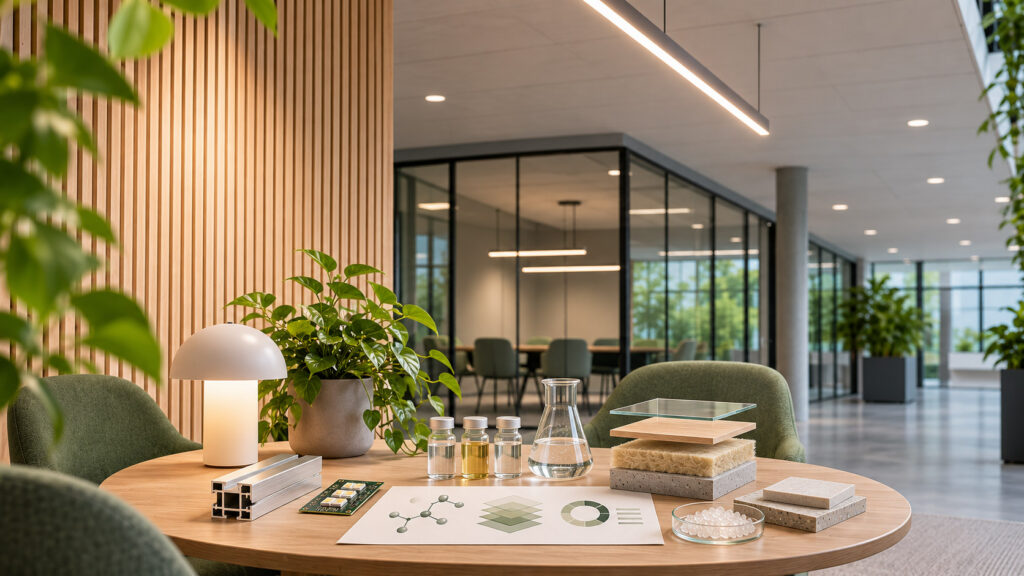
In short
Byggvarubedömningen assesses building products based on chemical content and selected environmental impacts throughout their life cycle. For LED -luminaires apply special electronics criteria, where Accepteras elektronik is the highest possible overall rating. The scheme does not assess light quality or energy use in a complete lighting system. For Swedish construction projects, environmental documentation, technical product data and correct lighting design are therefore important.
What is the Building Product Assessment?
Byggvarubedömningen is a Swedish scheme for the environmental assessment of construction-related products. It helps players in the construction industry identify and select products based on documented environmental properties.
The scheme primarily assesses two main areas:
- Chemical content: What substances the product contains, and whether these have properties that may be harmful to health or the environment.
- Life cycle aspects: Selected environmental aspects related to, among other things, raw materials, production and handling of the product after its end of life.
The assessments are based on criteria developed by Byggvarubedömningen, based on, among other things, the EU's chemicals regulations REACH and CLP.
Byggvarubedömningen is not a public technical standard or a certification of buildings. It is a product assessment scheme used to support environmentally conscious material selection and documentation in construction projects.
What does Recommended, Accepted and Avoided mean?
The products receive an overall assessment based on relevant criteria for chemical content and life cycle aspects.
| Rating | Importance |
|---|---|
| Recommended (green) | The product meets the criteria for the highest rating level. |
| Accepted (yellow) | The product meets the criteria for this level, but not all the requirements for Recommended. |
| Avoid (red) | One or more relevant criteria are considered Avoidable. |
The assessment applies to the product that has been registered and is based on the documentation submitted. It should therefore not be interpreted as a general approval of the manufacturer, the entire product range or its use in a specific construction project.
Why is the Building Product Assessment important for lighting?
Lighting systems consist of several materials and components. A LED -luminaire may contain, among other things, aluminum, steel, plastic, electronic components, cables, drivere and LED modules.
These components may contain substances that are subject to environmental and chemical requirements. The Building Product Assessment makes it possible to assess such conditions at the product level and gives builders and other project stakeholders a more structured basis for product selection.
For lighting suppliers, this means that it is not sufficient to document the luminaire's light output, power and lifespan. It may also be necessary to document material content, chemical substances and other environmental properties.
This is particularly relevant in Swedish construction projects where the client requires environmentally assessed products and registration in a digital material logbook.
LED - fittings have their own electronics criteria
An important difference between lighting products and many other building products is that LED -luminaires normally contain electronics.
The Building Product Assessment therefore has its own criteria for products with electronic components. These take into account that it can be difficult to document the complete chemical content of complex circuit boards and electronic components.
For such products, the content assessment is divided into two:
- Electronics: Circuit boards and associated electronic components are assessed according to specific criteria.
- Other: The product's other materials and components are assessed according to the ordinary criteria.
At the same time, relevant life cycle aspects are assessed for the entire product.
It is important to be aware that products with electronics cannot achieve the overall rating of Recommended according to these electronics criteria.
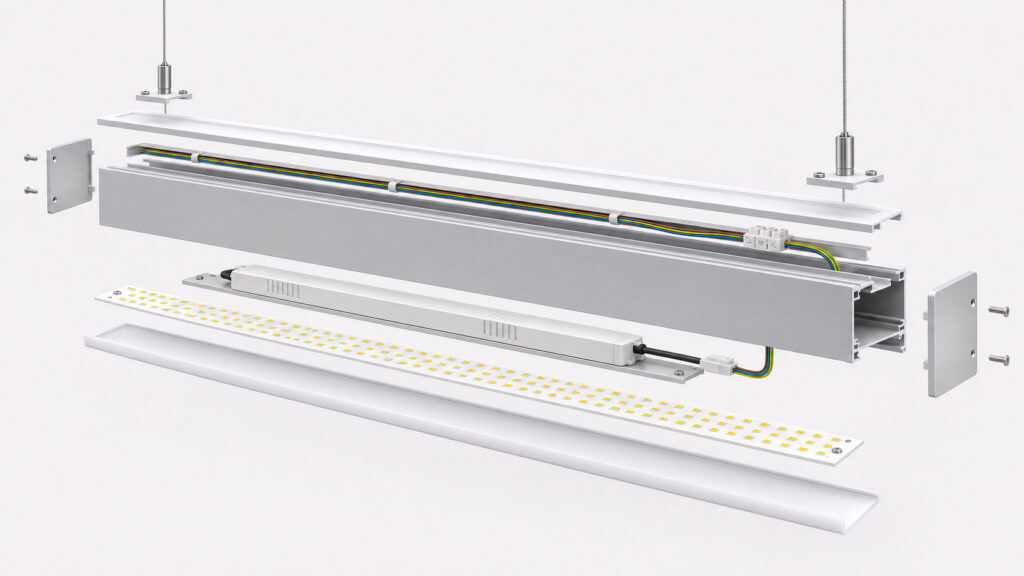
The highest possible level is Accepteras elektronik.
One LED -luminaires that have received this rating may have achieved the highest level available for the product type. The yellow rating does not necessarily mean that the luminaire has worse environmental properties than a non-electronic product with a green rating.
What documentation is required for lighting products?
In order for a luminaire to be assessed by Byggvarubedömningen, documentation must be available that describes the product and its material and substance content.
Some of the most important documents are:
| Document | What the document is used for |
|---|---|
| Construction goods declaration (BVD/eBVD) | Describes the product's materials, chemical content and other relevant information. |
| RoHS declaration | Documents compliance with relevant restrictions on hazardous substances in electrical and electronic equipment. |
| REACH/SVHC information | Provides information on relevant chemical substances, including substances on the EU candidate list. |
| EPD - Environmental Product Declaration | Provides standardized and third-party verified environmental data about the product's life cycle. |
| Technical documentation and FDV | Provides supplementary information about the product's features, installation, operation and maintenance. |
A construction product declaration or equivalent documentation is a basic requirement when applying for assessment. For electronic products, relevant RoHS documentation is also required.
An EPD is not mandatory for all products in the Building Assessment, but can contribute environmental data and provide a basis for a better assessment of certain life cycle criteria.
Is an EPD sufficient?
No. An EPD and an assessment at Byggvarubedomningen have different purposes.
An EPD describes the product's environmental impact through a standardized life cycle analysis. Byggvarubedömningen also assesses chemical content against its own criteria.
A product can therefore have a valid EPD without having a published assessment by Byggvarubedömningen. Similarly, a product can be assessed by Byggvarubedömningen without having an EPD.
Both types of documentation may be relevant, but they do not replace each other.
How is Byggvarubedömningen used in Swedish construction projects?
Byggvarubedömningen offers a digital logbook where project actors can register and follow up on products to be used in a construction project.
The logbook can be used by builders, contractors, consultants and suppliers, among others. It makes it possible to collect product information, document material choices and follow up on the project's environmental requirements.
When choosing lighting, it should be checked that:
- The relevant luminaire or product variant is identified.
- The product's environmental assessment has been updated.
- The documentation applies to the current combination of luminaire, electronics and accessories.
- The product satisfies the project's own requirements for material selection and logbook registration.
A product with the rating Accepted may be permitted in one project, but require special non-conformance handling in another. It is the project's environmental program and requirements specification that determine which ratings are accepted.
A published assessment by Byggvarubedömningen is therefore not a guarantee that the product can automatically be used in all Swedish construction projects.
The construction goods assessment compared to Norwegian environmental schemes
Norway and Sweden have much of the same regulatory framework for chemicals and electrical products, including REACH and RoHS. However, the national environmental assessment and certification schemes may have different methods, criteria and purposes.
It is particularly relevant to compare the Building Assessment with ECOproduct and BREEAM-NOR.
| Scheme | Main purpose | What is being assessed? |
|---|---|---|
| Byggvarubedomningen – Sweden | Environmental assessment of building products | Chemical content and selected life cycle aspects. |
| ECOproduct – Norway | Environmental assessment of building products | Including climate impact, resource use, substances hazardous to health and the environment, and indoor climate. |
| BREEAM-NOR – Norway | Environmental certification of buildings | The building's overall environmental performance, including energy, health, materials, pollution and project implementation. |
The construction goods assessment and ECOproduct
ECOproduct is a Norwegian method for assessing the environmental properties of building products. The method is based on environmental product declarations (EPDs) and supplementary documentation.
Both schemes contribute to more informed material choices and require documentation. However, they place different emphasis on environmental indicators and use different assessment methods.
An assessment in one scheme cannot therefore automatically be transferred to the other.
The construction goods assessment and BREEAM-NOR
The most important difference is what is being assessed.
Byggvarubedömningen assesses the individual product, while BREEAM-NOR assesses the overall environmental performance of a building or project.
BREEAM-NOR covers several conditions that are directly relevant to lighting:
- Visual comfort, including lighting levels, glare and flicker.
- Energy use and energy-efficient lighting solutions.
- Lighting control and adaptation to user needs.
- Product and environmental documentation, including EPD.
- Outdoor lighting and limiting light pollution.
However, the Building Product Assessment does not assess whether a completed lighting system meets requirements for lux level, glare, flicker or energy consumption in operation.
A luminaire with a positive rating from Byggvarubedömningen is therefore not necessarily the best solution in terms of light output or energy efficiency.
Similarly, high energy efficiency does not mean that the luminaire automatically meets the environmental criteria of Byggvarubedömningen.
Good lighting design must safeguard both the product's documented environmental properties and the quality of the overall lighting solution.
Environmental assessment and energy-efficient lighting must be seen in context
Energy efficiency is a key part of environmental work in construction projects. For lighting systems, the right choice of luminaires, good lighting planning and demand management can reduce energy consumption throughout the life of the building.
However, the Byggvarubedömning product assessment does not document the energy consumption of a finished lighting system. The previous sub-criterion for energy use in the use phase was removed from the scheme's criteria in 2022.
To document energy-efficient lighting, it is therefore necessary to look at other factors, including:
- The luminaires' system power and luminous efficacy.
- Number of luminaires and total installed power.
- Lighting calculations and correct sizing.
- Operating times and dimming options.
- Lighting control based on presence and daylight.
A good environmental choice is therefore about both which products are installed and how the lighting system is designed, controlled and used.
How can Norlux contribute?
In projects with environmental and documentation requirements, it is important to consider product selection and lighting solutions early in the process.
Norlux can assist with the selection of lighting products, lighting planning and relevant technical documentation. Where the project requires environmental assessments or special product documentation, it must be clarified which requirements apply and what documentation is available for the relevant products.
For Swedish projects, this includes investigating whether the fixtures have a current assessment by Byggvarubedömningen, and whether the documentation complies with the project's material and logbook requirements.
By viewing product documentation, lighting design and lighting control in context, Norlux can contribute to lighting solutions that meet environmental requirements, functionality and energy-efficient operation.
Frequently asked questions about Building Product Assessment
Are you planning a lighting project?
Norlux helps you find lighting solutions tailored to your project's needs – from lighting design and product selection to control and documentation.