

Human Centric Lighting (HCL) – light adapted to people and circadian rhythms
Human Centric Lighting (HCL) is about adapting lighting to the people using the space, their activities and the time of day. With dynamic lighting control, both light levels and color temperature can be adjusted throughout the day. This is particularly relevant in hospitals, healthcare buildings, offices and other environments where needs vary. Norlux can deliver solutions with very warm light down to 2200 K, which provides flexibility when adapting lighting to different activities and times of day.
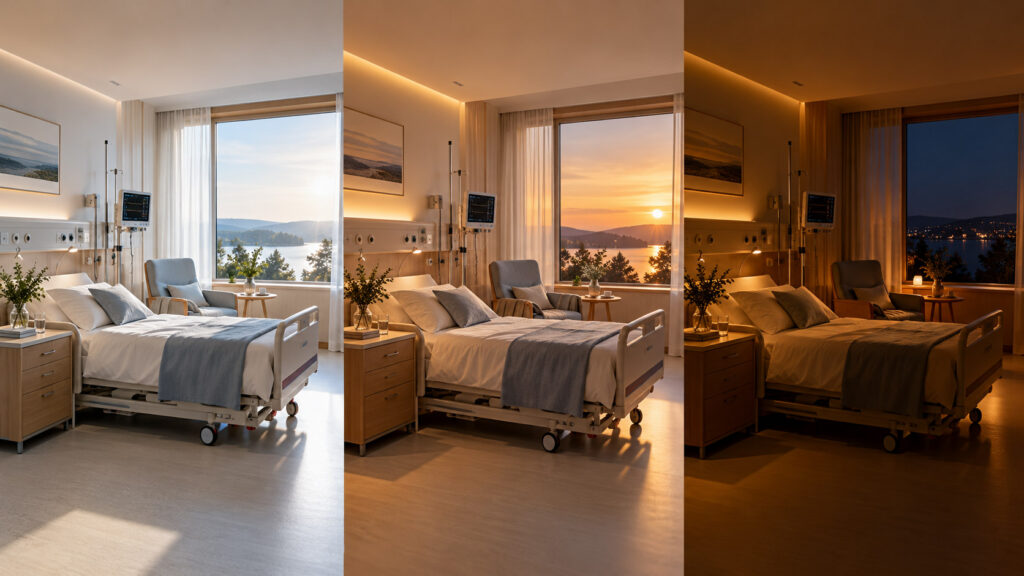
In short
Human Centric Lighting (HCL) is human-oriented lighting that takes into account both visual needs and the impact of light on the circadian rhythm. By adapting light levels, color temperature and light exposure throughout the day, flexible lighting environments can be created for different activities and user needs. Norlux offers solutions with dimmable light, including warm color temperatures down to 2200 K.
What is Human Centric Lighting (HCL)?
Traditional lighting is designed primarily to ensure good viewing conditions. We set requirements for, among other things, light level, uniformity, color rendering and glare.
Human Centric Lighting takes these requirements into account, but also includes the non-visual effects of light. Research shows that light exposure affects the human circadian rhythm, and that intensity, spectral composition, timing and duration all matter.
Daylight is a natural starting point. Throughout the day, both the amount of light and the nature of the light vary. In the morning and during the day, light exposure helps to synchronize the biological clock, while reduced light exposure in the evening and at night is important for the natural circadian rhythm.
An HCL solution can be adapted to this process using adjustable LED -lighting and programmed light settings.
In the field of lighting, the term is also used integrativ belysning, which describes lighting where both visual and non-visual effects are included in the planning.
Light that follows the rhythm of the day and night
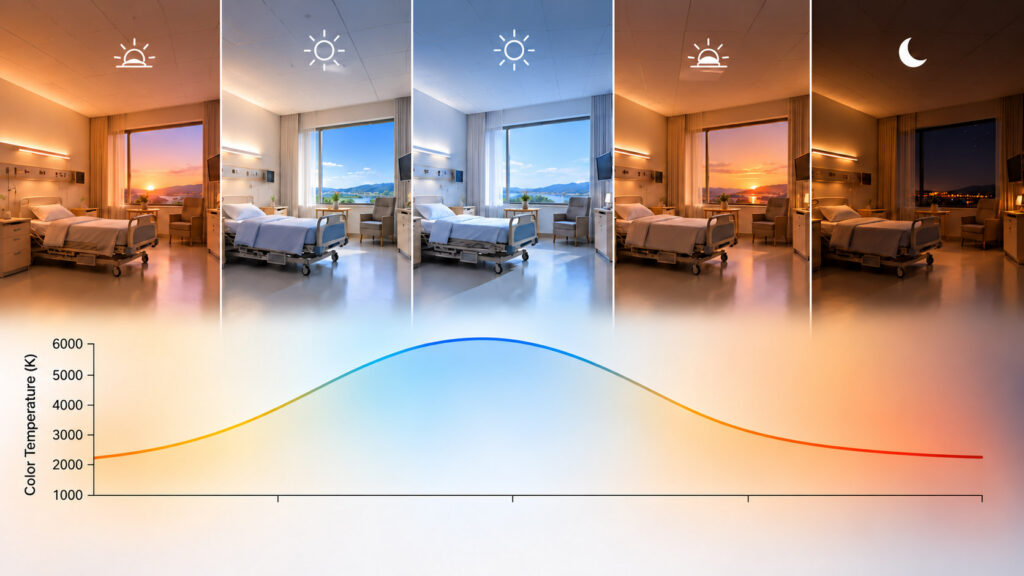
A well-thought-out HCL solution takes into account that the need for light changes throughout the day. By combining dimmable luminaires with intelligent lighting control, lighting can be adapted to different activities and times of day.
Morning and day
During the day, it is important to have sufficient light for work, activity and orientation. In rooms with limited access to daylight, electric lighting can contribute to the desired light exposure. The light level and spectral composition are adapted to the function of the room and the users.
Afternoon and evening
As activity levels change, lighting can be gradually adjusted to a lower level and a warmer color temperature. This can contribute to a calmer lighting environment and reduce unnecessary light exposure before nightfall.
Night
At night, it may be desirable to limit both the amount of light and the short-wavelength part of the light. At the same time, the lighting must ensure safe movement, orientation and necessary work tasks. Extra warm light or special Amber solutions may be appropriate, depending on the area of application.
The transitions can be programmed so that the lighting environment changes gradually, while giving users the opportunity to override the lighting when the situation requires it.
Extra warm light - all the way down to 2200 Kelvin
A particularly interesting option in Norlux's lighting solutions is very warm light, with color temperatures as low as 2200 K.
Kelvin (K) describes the color temperature of light. Lower values produce a warmer, more golden light, while higher values produce a cooler, whiter light.
In comparison, regular warm white has LED -lighting often has a color temperature of 2700–3000 K. With 2200 K, you can create a significantly warmer lighting environment that is visually more reminiscent of flames or candles.
This provides interesting opportunities in areas where a subdued and pleasant lighting environment is desired in the evening and at night, for example in patient rooms, corridors and common areas in healthcare buildings.
Very low color temperature can also be a tool when one wants to limit shortwave light exposure. The actual biologically relevant light exposure, however, depends on the spectrum of the light source, the light level at the eye and how long one is exposed to the light.
What is the difference between 2200 K and Amber lighting?
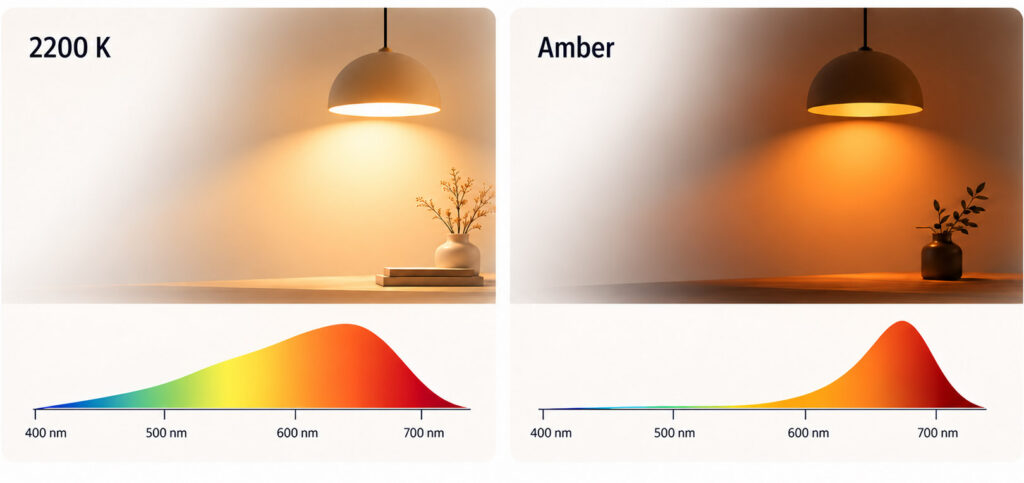
Amber lighting is characterized by light with a predominance in the long-wavelength part of the visible spectrum. Such solutions may be relevant when one wishes to further limit short-wavelength light exposure.
However, a very warm white light of 2200 K is not automatically the same as Amber. Two light sources can give an approximately similar color impression, but have different spectral composition.
Therefore, it is important to consider documented spectral data, not just color temperature, when planning biologically relevant lighting.
Human Centric Lighting in hospitals and healthcare buildings
Hospitals and healthcare facilities place particularly high demands on lighting. The buildings are often used around the clock, and the needs of patients, relatives and staff can be very different.
Patients need the opportunity to rest, while healthcare professionals need sufficient light for observation, treatment and other tasks. Lighting must therefore be flexible and adapted to different situations.
Patient room
In patient rooms, lighting can be adapted to different activities throughout the day. Good lighting conditions are important for examinations, care and reading, while a lower and warmer light level may be desirable for rest and at night.
With a flexible control solution, staff can access the necessary working light while the patient has the option of a more subdued lighting environment when the situation allows.
Corridors and common areas
Here, the lighting must ensure both safe orientation and comfort. A solution with different lighting settings can provide good visibility during the day and a more subdued lighting environment at night, without disregarding necessary safety requirements.
Psychiatry and care
In psychiatric wards and care buildings, the lighting environment can be particularly important to consider because residents and patients may spend large parts of the day indoors.
Dynamic lighting allows you to adapt the light to your daily routines, activity and rest. At the same time, extra warm light and adapted night lighting can contribute to a calmer visual environment.
The solution must be planned in close collaboration with the client, operating personnel and relevant professional groups. The lighting must also meet requirements for safety, functionality and individual adaptation.
Staff room and treatment room
Healthcare professionals work at different times of the day and need functional lighting. In treatment and examination rooms, requirements for visibility, color rendering and task lighting must always be prioritized.
Lighting control can contribute to flexibility between different work situations. Staff rooms, in turn, may require different lighting settings than treatment areas.
Human Centric Lighting is a supplement to good ordinary lighting design, not a substitute for medical treatment or clinical light therapy.
HCL is more than Tunable White
Tunable White is a LED -technology that makes it possible to regulate the color temperature of the light, usually in combination with dimming.
Human Centric Lighting, on the other hand, is a holistic lighting concept.
A fixture with Tunable White can be an important part of an HCL solution, but changing the color temperature alone is not sufficient.
To design a good solution, one must also take into account:
- Light level and light distribution
- The spectral composition of light
- Timing and duration of light exposure
- Access to daylight
- Room function and activities
- Users' individual needs
- Management, flexibility and energy use
In projects with special requirements for biologically relevant lighting, melanopisk EDI is used. This is a measurement that describes melanopic light exposure, based on how much light reaches the eye and the spectral composition of the light.
The value provides a more relevant basis for assessing this part of light exposure than Kelvin and regular illuminance alone, but it cannot be used to predict specific health or sleep outcomes for an individual.
A good HCL solution therefore requires both the right technology and well-thought-out lighting planning.
HCL in schools and rooms with limited daylight
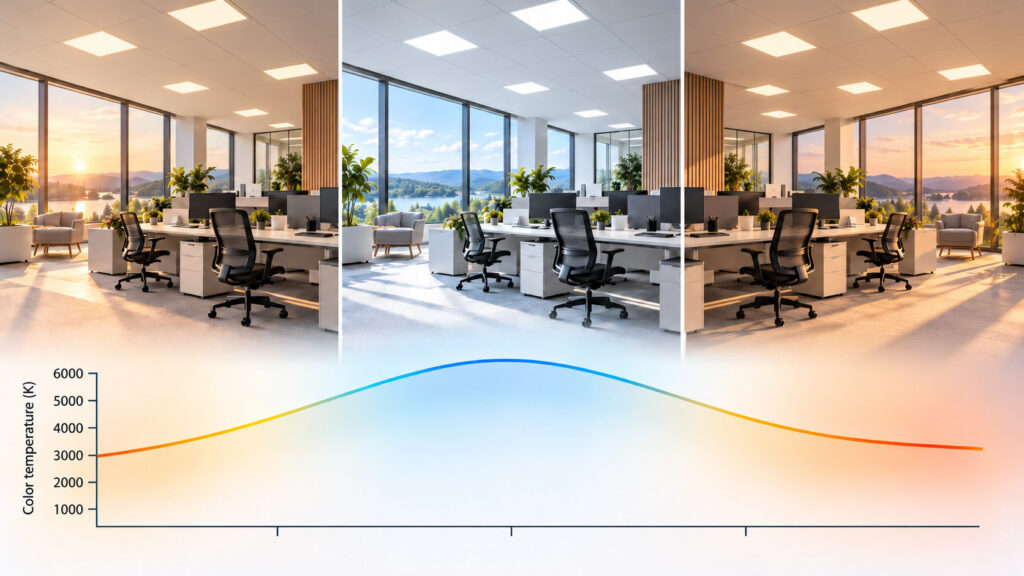
Human Centric Lighting is also relevant in schools, classrooms and other areas with limited access to daylight. Here, dimmable lighting can help adapt the lighting environment to different activities throughout the day.
In classrooms, for example, different lighting settings may be appropriate for concentration work, group work and quieter activities. Adjusting the light level and color temperature provides greater flexibility, but must always be combined with good viewing conditions and consideration for the needs of the users.
In rooms with little daylight, dynamic electric lighting can be a useful supplement. The solution must be designed based on the room's function, usage time and relevant lighting requirements.
How can Norlux contribute?
A good HCL solution is about more than choosing the right luminaire. The lighting must be designed based on the building's function, daylight access, the users' needs and current requirements for the lighting environment.
Norlux can contribute throughout the entire process, from needs analysis and lighting design to product selection, lighting calculations, lighting control and technical documentation.
With a wide selection of luminaires and control options, we can develop solutions that combine functional lighting with adaptation of light throughout the day.
For healthcare buildings, this may include different lighting settings for day, evening and night, with the option of extra warm light and individual adjustments.
At the same time, requirements for visual comfort, energy efficiency, safety and operation must be met. The result should be a well-thought-out lighting solution that works for both the people who use the building and those who will operate it.
Frequently Asked Questions about Human Centric Lighting
Are you planning a lighting project?
Norlux helps you find lighting solutions tailored to your project's needs – from lighting design and product selection to control and documentation.