

What is an EPD – and what does it tell you about a lighting product?
An EPD documents a product's environmental impact throughout defined parts of its life cycle. For LED For luminaires, it provides information on the climate footprint of materials, production, transport and energy use, among other things. But what do the numbers mean in practice, and what should you know before using an EPD to compare lighting products?
In short
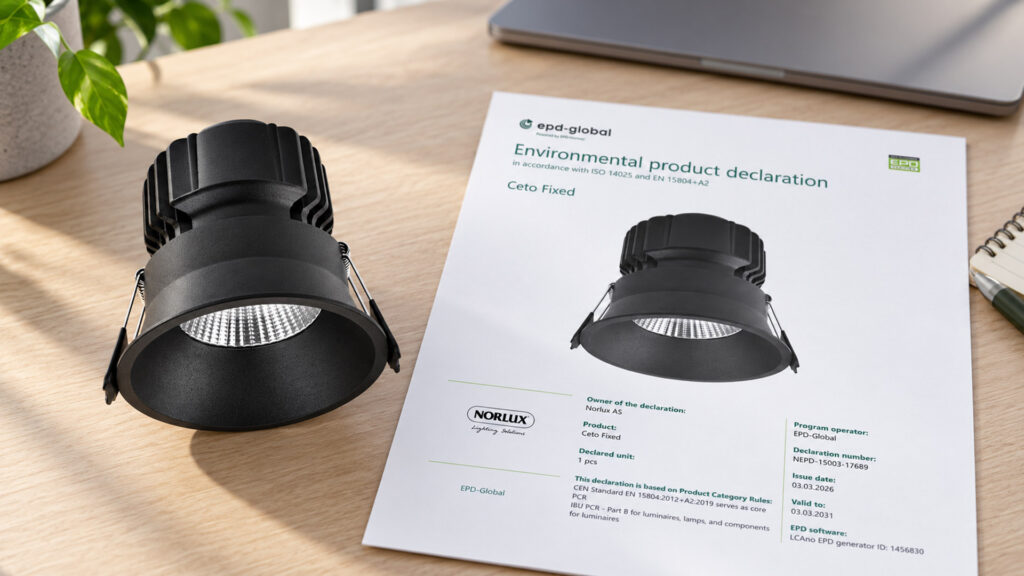
An EPD (Environmental Product Declaration) is a standardized and third-party verified environmental declaration based on a life cycle assessment (LCA). It documents, among other things, the product's climate footprint, measured in CO₂ equivalents (CO₂-e). EPDs are used in construction projects to document environmental impact and provide a better basis for product selection. However, an EPD is not an eco-label or a guarantee that a product is sustainable.
What is an EPD?
EPD stands for Environmental Product DeclarationAn EPD is a standardized environmental declaration that describes the environmental impact of a product in a verifiable manner.
The basis of an EPD is a life cycle analysis, often abbreviated as LCA (Life Cycle Assessment). The analysis maps resource use and environmental impact through defined parts of the product's life cycle, from raw material extraction and production to use and disposal.
An EPD is prepared according to international standards and product category rules (PCR). ISO 14025 is the basic standard for this type of environmental declaration. For construction products, EN 15804 is also central.
Before an EPD is published, the documentation must be verified by an independent third party. This provides a more verifiable basis than the manufacturer's own, undocumented environmental claims.
What does an EPD tell you about a lighting product?
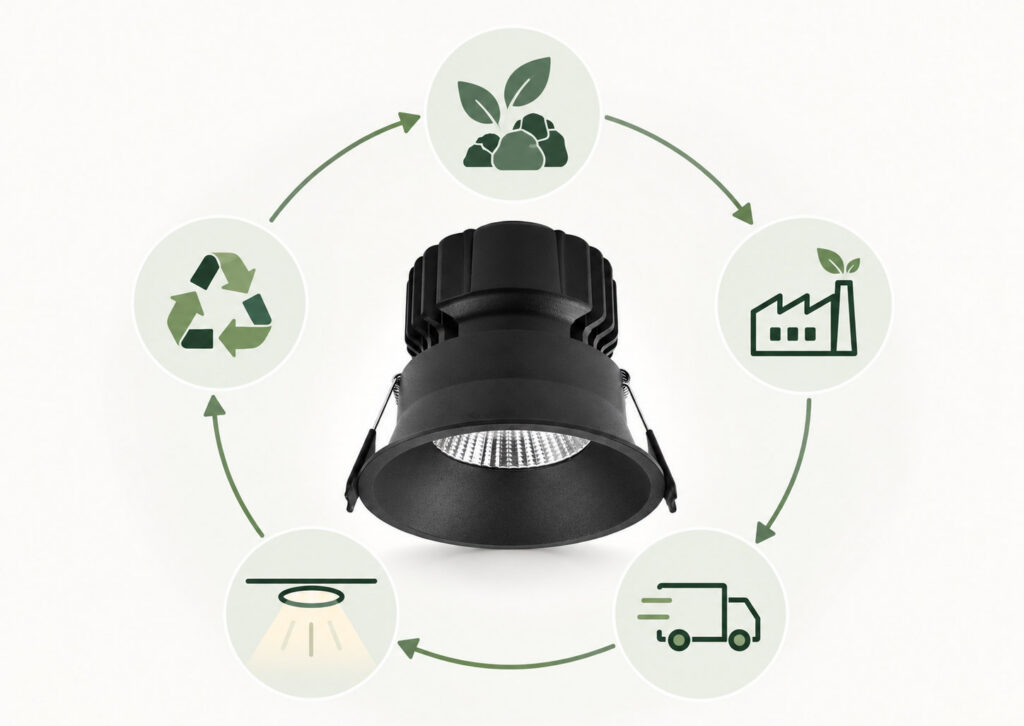
For one LED -luminaire, the environmental impact can occur in several parts of the life cycle:
- Materials: Extraction and production of, among other things, aluminum, plastic, glass and electronic components.
- Production: Energy and resources used to produce and assemble the fixture.
- Transportation: Transportation of raw materials, components and finished products.
- Usage: The electricity the fixture consumes throughout its period of use.
- End of life: Dismantling, waste management and possible material recycling.
A key indicator is the climate footprint, expressed in CO₂ equivalents (CO₂-e). This is a common unit of measurement that makes it possible to express the climate impact of different greenhouse gases on the same scale.
An EPD may also contain other environmental indicators, for example related to resource use, waste and various forms of environmental impact. The results reported depend on the standards and product category rules used.
It is important to investigate which life cycle phases are actually included in the declaration in question. Not all EPDs cover the same phases.
Which lifecycle phases are included in an EPD?
For EPDs following EN 15804, the product life cycle is divided into modules. This division makes it easier to understand where the environmental impact occurs.
| Module | What the module includes |
| A1–A3 | Raw materials, transportation to production and manufacturing |
| A4–A5 | Transport to construction site and installation |
| B1–B7 | The use phase, including maintenance, replacement and energy use |
| C1–C4 | Dismantling, transport, waste treatment and final disposal |
| D | Possible environmental benefits and burdens outside the product's life cycle system, for example from material recycling |
Module D is reported separately and should not be simply deducted from the emissions in the other modules.
For some electrical products, different standards and life cycle classifications are used. It is therefore important to read which method and which modules the specific EPD is based on.
Why is B6 particularly important for LED -lamps?
In an EPD according to EN 15804, module B6 describes the energy use in the use phase. For lighting products, this can be a significant part of the calculated climate footprint.
B6 is influenced by, among other things, the luminaire's power, expected operating time, calculation period and the assumptions used for electricity production.
The result is based on a defined usage scenario. This means that the calculated energy use in the EPD does not necessarily correspond to the actual energy use in a specific building.
For example, a luminaire combined with presence sensors, daylight control or other demand control can have lower actual energy consumption than when operating continuously at full power. The extent of the difference depends on how the lighting system is designed, programmed and used.
The EPD thus documents a calculated scenario, while the project's actual energy use must be assessed based on the specific lighting solution.
Can you compare two luminaires with EPD?
Yes, but not necessarily by comparing a single CO₂-e number.
Even if two luminaires have third-party verified EPDs, that doesn't automatically mean that the results can be directly compared.
For a meaningful comparison, one must consider, among other things, whether the products have a similar function and whether the declarations are based on comparable assumptions.
It is particularly important to check:
- Whether the products cover the same lighting needs.
- Whether they have the same or comparable declared or functional unit.
- Which lifecycle phases and modules are included.
- What assumptions have been used for lifespan, operating time and energy use.
- Whether the EPDs are based on comparable product category rules and calculation methods.
For example, two luminaires may have different power, light output, light distribution and lifespan. A luminaire with lower emissions from production is therefore not necessarily the option with the lowest overall climate footprint when it is included in a finished lighting system.
The EPD is an important basis for decision-making, but must be considered together with the technical characteristics of the luminaire and the needs of the project.
What are EPDs used for in construction projects?
EPDs are used by, among others, developers, consultants, contractors and purchasers who need documentation of the environmental impact of products.
The documentation may include:
- Greenhouse gas calculations for buildings and technical installations.
- Tender processes and public procurement.
- Environmental assessments when choosing products and materials.
- Documentation work in projects that follow BREEAM-NOR or other environmental certification schemes.
In a construction project, EPDs can make it easier to collect product-specific environmental data, compare relevant alternatives, and highlight which parts of the delivery contribute to the climate footprint.
However, an EPD does not automatically count towards an environmental certification. It is the project's applicable requirements and documentation rules that determine how the information can be used.
Is EPD required by law?
There is no general requirement that all LED -Fixtures sold in Norway must have an EPD.
An EPD may still be necessary to meet documentation requirements in a specific procurement or construction project. This may result from requirements from the client, the tender documents or an environmental certification scheme.
The requirements must therefore be assessed for each individual project.
What does an EPD not tell you?
An EPD provides valuable environmental information, but does not document all factors that are included in a comprehensive sustainability assessment.
It is not a quality seal and does not in itself mean that a product has a low environmental impact.
An EPD also does not necessarily provide sufficient information about:
- Chemical content: Whether the product contains certain substances that are harmful to health or the environment.
- Labor conditions: How human rights, working conditions and responsible business practices are safeguarded in the supply chain.
- Product quality: Whether the luminaire has sufficient light output, operational reliability or lifespan for the project.
- Actual energy use: How much electricity the lighting system will use after installation and commissioning.
For a broader assessment, several types of documentation are therefore needed.
For example, the Byggvarubedömningen can provide information about product content and selected environmental conditions, while the CE marking and associated conformity documentation apply to compliance with relevant European product requirements.
Documentation about supply chains and due diligence assessments covers other matters.
None of these types of documentation alone provides a complete picture of the product's sustainability performance.
Norlux's work with EPD
Norlux works systematically to document the environmental impact of our products and make relevant information available to customers and partners.
We prepare the basis for EPD calculations internally. This involves collecting and processing product data on materials, weight, energy use and transport. The documentation is then checked and verified by an independent third party before the EPD is published.
The work gives us better insight into where the climate footprint arises throughout the product's life cycle. This knowledge can be used in product development, supplier dialogue and assessment of possible improvements.
For customers, the EPD documentation means a more verifiable basis for product selection, climate calculations and projects with specific environmental requirements.
For Norlux, EPD is therefore not just about delivering a document, but also about actively using product data in the work on better lighting solutions.
Frequently asked questions about EPD
Are you planning a lighting project?
Norlux helps you find lighting solutions tailored to your project's needs – from lighting design and product selection to control and documentation.