

What is UGR – and what does it tell us about glare?
Good lighting is not just about having enough light. The light must also be comfortable to stay in and work in. A luminaire that provides sufficient light on the work surface can still be perceived as dazzling if it is incorrectly positioned or has too high a brightness in the direction of view. UGR is a method for assessing the risk of such discomfort glare.
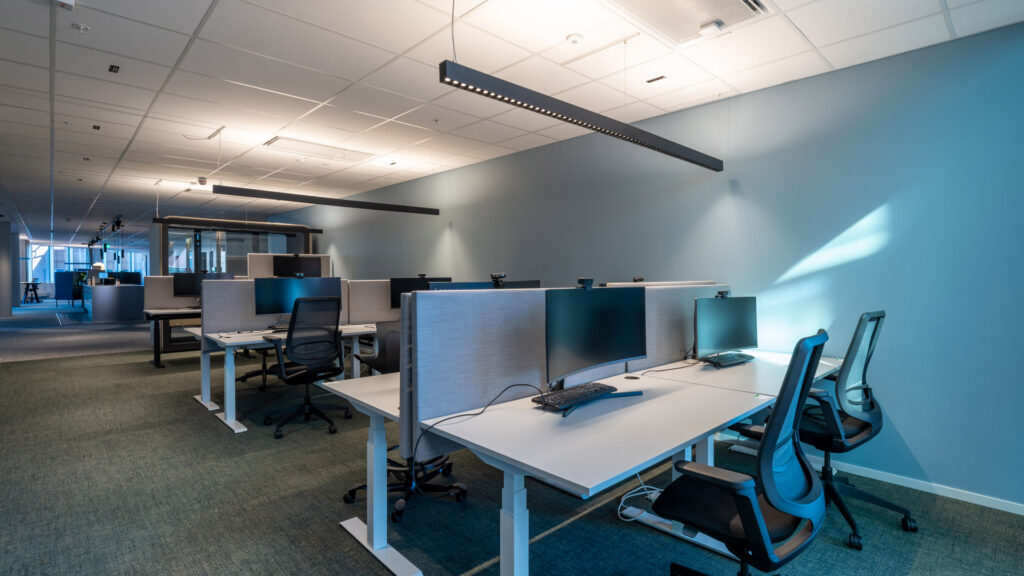
In short
UGR stands for Unified Glare Rating and is a method for calculating discomfort glare from indoor lighting systems. The lower the UGR value, the lower the risk that the lighting will be perceived as dazzling. For typical office workplaces, the limit value is normally 19, but the requirements vary depending on the function of the room and the work tasks. UGR must be assessed for the entire lighting solution, not just based on the characteristics of one luminaire.
What is glare?
Glare occurs when the eye is exposed to high luminances or large differences between light and dark areas in the field of vision. This can happen, for example, when looking at a strong light source, or when the light from a luminaire is reflected off a shiny surface.
A distinction is mainly made between two types of blending:
- Discomfort glare: Light that is perceived as annoying or unpleasant, although it does not necessarily impair the ability to see details. Over time, such glare can be distracting and tiring.
- Visually impairing glare: Light that reduces vision by weakening contrasts in the field of vision. A typical example is the headlights of an oncoming car in the dark.
In offices, schools, meeting rooms and other work environments, controlling discomfort glare is an important part of lighting design. Here, UGR is used as a standardized method to assess glare from luminaires.
What does UGR mean?
UGR is an abbreviation for Unified Glare RatingThe method was developed by the International Commission on Illumination (CIE) and described in publication CIE 117.
UGR is expressed as a number without a unit of measurement. The method takes into account several factors that affect how dazzling a lighting installation can be perceived:
- Luminance of the luminaires: How bright the luminous surfaces of the luminaires appear in the viewer's direction of view.
- The size of the light sources: How large a portion of the field of view the illuminating surfaces occupy.
- Luminaire location: Where the light sources are located in relation to the eyes and the direction of view.
- Background brightness: How bright the surroundings are compared to the fixtures.
For example, a powerful light source in an otherwise dark room may be perceived as more dazzling than the same light source in a room with brighter surroundings.
The UGR calculation takes this interaction into account. The result provides a basis for comparing the lighting solution with the limit values for the current use of the room.
What is a good UGR value?
A low UGR value means less likelihood of uncomfortable glare. However, there is no single value that suits all rooms and work tasks.
The standard NS-EN 12464-1:2021 specifies limit values for different types of indoor workplaces. The values follow a scale where lower numbers imply stricter requirements for glare control.
Here are some examples from Lyskultur's Luxtabell 1B:
| Area or task | UGR limit value |
|---|---|
| Office workplace | 19 |
| Reception desk | 22 |
| Corridor (general traffic area) | 28* |
* UGR 28 applies to general corridors and traffic areas. Other types of corridors may have stricter limits, for example corridors in schools and hotels (UGR 25) and some corridors in healthcare buildings (UGR 22). When designing, the relevant room type and the conditions in adjacent areas must be considered.
The values are upper limits for the specified applications, not targets that the lighting should attempt to achieve.
What does UGR 19 mean?
UGR 19 is a widely used limit value for office lighting, especially for reading, writing and screen work.
When a lighting system is designed with a limit value of 19, it means that the discomfort glare should be limited to this level according to the standard's assessment method.
But a UGR value of 19 does not mean that no one will experience glare. People have different sensitivities to light, and the actual experience is also affected by factors such as daylight, reflections, contrasts and individual vision needs.
A good lighting environment must therefore be assessed based on more factors than UGR alone.
Is a luminaire with a UGR below 19 always glare-free?
No. This is an important distinction between product information and projected lighting.
Mange LED-armaturer markedsføres med betegnelser som «UGR < 19». Det forteller at armaturen kan oppnå en UGR-verdi under 19 under bestemte beregningsforutsetninger. Det betyr imidlertid ikke at den automatisk vil gi samme resultat i alle rom.
The actual risk of glare depends on, among other things:
- room size and ceiling height
- number of fixtures and their location
- the luminaires' light distribution and mounting direction
- the reflection properties of walls, floors and ceilings
- where people are and what direction they are looking
A fixture that works well in one office may therefore provide a less satisfactory result in another.
UGR is primarily a property of the lighting installation, not a fixed value for a single luminaire.
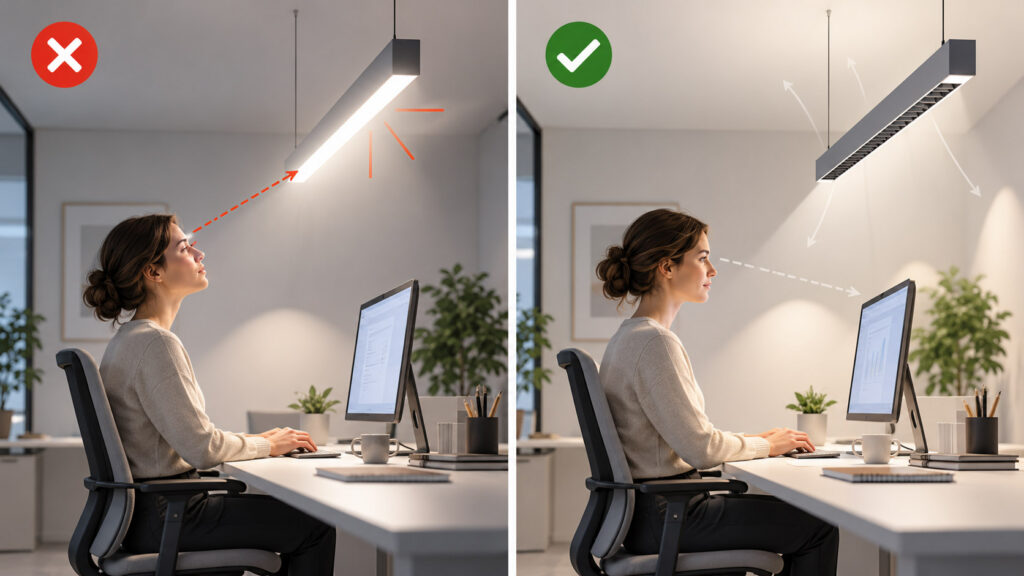
To document the glare conditions, one must take into account the planned installation and use an assessment method that is suitable for the solution.
How is UGR calculated and documented?
UGR is calculated using the luminaires' photometric data, combined with information about the room and the lighting installation.
For standardized installations, the UGR table method, which is described in CIE 117, is often used. The method is based on certain assumptions about, among other things, room shape, luminaire placement and light distribution.
In modern lighting projects, lighting calculation programs such as DIALux and Relux are also used to analyze the installation.
It is important to be aware that calculated UGR values for specific observer positions cannot be directly compared with the standard's tabular limit values. The calculation method and assumptions must be documented.
The UGR table method also has limitations. It is not directly applicable to all types of lighting solutions, for example some asymmetrical luminaires, adjustable spotlights or solutions with only indirect lighting. Such installations require their own professional assessments.
What is the difference between UGR, RUG and RUGL?
UGR is the established international designation for the method Unified Glare Rating.
The following symbols are also used in NS-EN 12464-1:2021:
- RUG: The calculated value for discomfort glare according to the UGR method.
- RUGL: The threshold value for discomfort glare specified for the relevant task or room type.
The difference lies mainly in how the calculated value and limit value are designated in the standard. The UGR method itself remains the same.
In product information and general communication in the lighting industry, the term UGR is still widely used.
How to reduce glare in a lighting system?
Good glare control starts in the planning stage. It is not always necessary to reduce the amount of light to achieve more comfortable lighting conditions. Often it is a matter of using and distributing the light better.
Some important measures are:
- Choose luminaires with good shielding. Optics, reflectors and diffusers can help reduce direct visibility from very bright surfaces.
- Plan the luminaire placement. Location in relation to workplaces, viewing directions and mounting height affect the risk of glare.
- Create a balanced light distribution. Lighting walls and ceilings can brighten the room and reduce large luminance differences between fixtures and surroundings.
- Consider reflections. Glossy table surfaces, screens, glass and other reflective materials can create annoying glare even when direct glare from fixtures is well controlled.
- Use flexible lighting control. Dimming and individual adjustment options make it easier to adapt lighting to different activities and users.
The goal is to achieve sufficient light for the tasks to be performed, while the lighting provides good visual comfort.
Good lighting requires more than just the right UGR
UGR is one of several important quality criteria when planning indoor lighting.
In addition, one must consider, among other things, illuminance (lux), uniformity, color rendering, light distribution, daylight and user needs.
A room can have the right illuminance and satisfactory UGR, but still feel uncomfortable if the walls and ceiling are too dark, or there are disturbing reflections from work surfaces.
Therefore, lighting planning should be based on how the room will actually be used, not just the values stated in the luminaire data sheet.
At Norlux, we work with holistic lighting solutions where luminaire selection, lighting calculations, placement and lighting control are considered in context. The goal is to create functional and comfortable lighting environments that meet the project's needs and relevant lighting requirements.
Frequently asked questions about UGR and glare
Are you planning a lighting project?
Norlux helps you find lighting solutions tailored to your project's needs – from lighting design and product selection to control and documentation.