

How can lighting control reduce energy consumption?
Lighting control is an effective tool for reducing energy consumption for lighting. By adjusting the lighting according to presence, daylight, time of day and how different areas are used, unnecessary energy use can be avoided. With proper planning, this can result in lower operating costs while maintaining good lighting quality and comfort.
In short
Lighting control reduces energy consumption by providing the right light, in the right place, at the right time. Sensors, daylight control, schedules and zoning can reduce both operating time and average power. The solutions are relevant both in new buildings and when upgrading existing lighting systems. The amount of savings depends on the use of the building, the lighting system and how the control is set up.
Why is lighting control important for energy consumption?
The energy consumption of a lighting system depends on more than just how efficient the luminaires are. Even modern LED Luminaires can use an unnecessary amount of energy if they are on full power when light is not needed.
In office buildings, public buildings, shops, warehouses and other commercial buildings, the need for lighting varies throughout the day. Some areas have constant activity, while others are only used for short periods. Daylight access can also vary significantly between rooms and zones.
With lighting control, lighting can be adapted to these variations, reducing the need to leave the entire facility fully illuminated during fixed operating times.
Good energy efficiency is therefore both about using efficient luminaires and controlling the light according to actual needs.
Five ways lighting control can reduce energy consumption
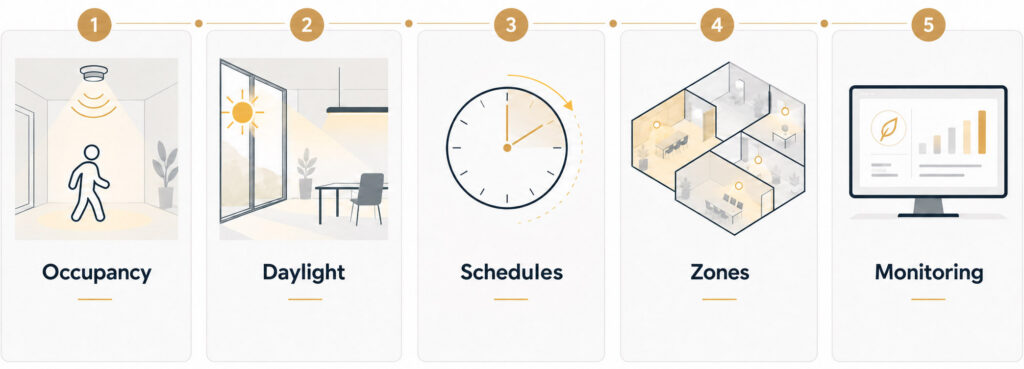
1. Presence control – lights when someone is present
Sensors detect activity in an area and can automatically turn on, dim or turn off the lighting.
This is particularly relevant in rooms and areas with varying uses, such as meeting rooms, cell offices, corridors, changing rooms, warehouses and parking facilities.
When the area is without activity, the lighting can be reduced to a predefined level or turned off completely.
To achieve a good experience, sensor placement, sensitivity and time delays must be adapted to the function of the room. The light should respond to the use of the area without being perceived as disruptive or compromising safety.
2. Daylight control – make the most of natural light
In rooms with windows, daylight can cover a significant portion of the lighting needs throughout the day. However, many lighting systems are programmed to provide the same level of light regardless of the amount of daylight available.
With daylight control, the electric lighting can be dimmed automatically when daylight provides sufficient light.
This is particularly relevant in offices, classrooms, entrance areas and other areas with good access to daylight.
Daylight control can be combined with constant light control, which helps maintain a desired lighting level. This allows the system to adapt the electrical lighting throughout the day without users having to manually adjust the light.
3. Time management – avoid unnecessary operation
The need for lighting is rarely the same throughout the day.
With time control, lighting can be programmed according to the building's opening hours, working hours and other fixed usage patterns.
For example, light levels can be automatically reduced after working hours, or lighting can be turned off in areas that are not normally used at night and on weekends.
Time control can also be combined with presence sensors, so that lighting is still available during activity outside normal working hours.
4. Zoning – the right light where it's needed
Different parts of a building have different lighting needs. However, in many facilities, lighting is controlled in large groups, which can result in several areas being illuminated at the same time even if only parts of them are in use.
By dividing the lighting into smaller zones, the light level and operating time can be adapted to the individual function.
In an office building, for example, meeting rooms, office spaces, corridors and social zones can be controlled individually. Workplaces near windows may also have different needs for electric lighting than areas further into the building.
Good zoning provides more precise control and makes it easier to adapt lighting if the use of the premises changes.
5. Energy monitoring – understand and optimize consumption
A lighting control system can also provide a better overview of how the lighting is used.
Depending on the system's functionality, information about operating hours, dimming levels, activity and energy usage can be used to identify areas with unnecessarily high consumption.
Such information can provide a basis for adjusting schedules, sensor settings and light levels.
Lighting control is therefore not necessarily a one-time measure. By following up on the system over time, the control can be adapted to changes in usage patterns and needs.
Lighting control in new buildings and during renovation
The basic principles of energy-efficient lighting control are the same whether it is a new building or an upgrade of an existing facility. The difference lies primarily in how the solution is planned and implemented.
Lighting control in new buildings
In new buildings, luminaires, sensors, zones and control systems can be planned as an integrated part of the lighting system from the start.
This makes it possible to adapt the solution to room functions, daylight conditions, expected use and the building's other technical systems.
Good planning in the early phase can also contribute to better usability, flexibility and documentation of energy use.
Upgrading existing lighting systems
When rehabilitating, the solution must be based on the existing installation.
In some buildings it may be possible to upgrade the control without replacing all the fixtures. Other facilities may benefit more from combining replacement with energy-efficient ones. LED - fixtures with modern light control.
Wireless control systems may be particularly relevant where one wants to limit the need for new control cabling.
The choice of solution should be based on an assessment of the existing facility, technical compatibility, desired features and the cost of the upgrade.
How much energy can be saved with lighting control?
There is no single percentage that applies to all lighting systems. The savings depend on factors such as installed power, daily operating hours, daylight availability, usage patterns and how the control is programmed.
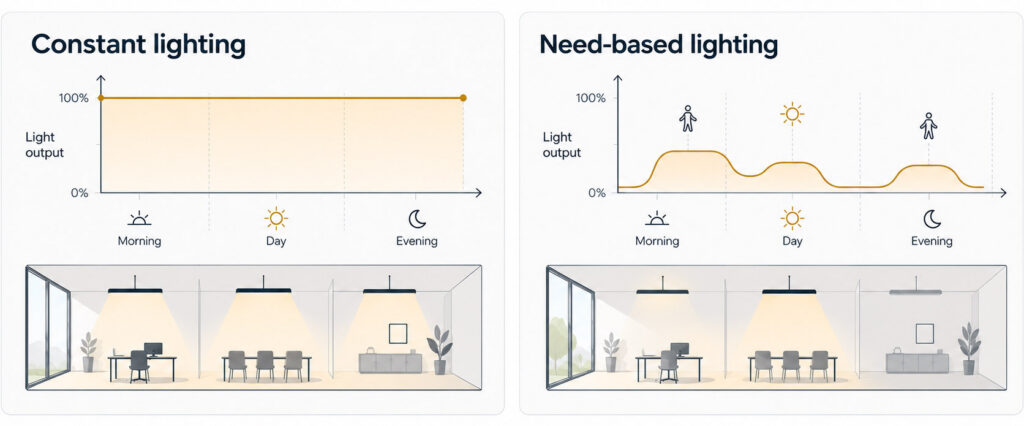
A building where the lighting is already well adapted to the use will normally have a different savings potential than a building where large areas are fully illuminated throughout the day or 24 hours a day.
To assess energy savings, one should map current facilities and establish a basis for comparison.
This may include, among other things:
- Installed power before and after the measure
- Operating time and usage pattern
- Dimming and programmed light levels
- Sensors, schedules and zoning
- Daylight conditions
- Calculated or measured energy use
It is important to distinguish between expected and documented energy savings. Calculations can be used to assess the potential before installation, while measurements and relevant operational data can be used to evaluate the result afterwards.
Energy efficiency must not come at the expense of light quality
The goal of lighting control is not to use the least amount of light possible, but to use the right amount of light at the right time.
Lighting must still meet users' needs for visual comfort, orientation, safety and good working conditions.
Light levels, glare, uniformity, contrasts and other quality requirements must therefore be considered together with energy use. For indoor workplaces, NS-EN 12464-1 and Lyskultur's Luxtabell 1B are central parts of the professional basis.
User-friendliness is also important. If the control is perceived as complicated or unpredictable, users may end up overriding the automation. This can reduce both functionality and the expected energy savings.
Good design, correct programming and follow-up after commissioning are therefore crucial for a successful result.
How can Norlux contribute to energy-efficient lighting control?
Norlux helps customers plan and implement lighting projects where energy efficiency, functionality and user-friendliness are considered as a whole.
We can assist with, among other things, lighting design, lighting calculations, product selection, zoning, lighting control and documentation.
Through our work with Light Management Systems We offer various solutions for controlling professional lighting systems.
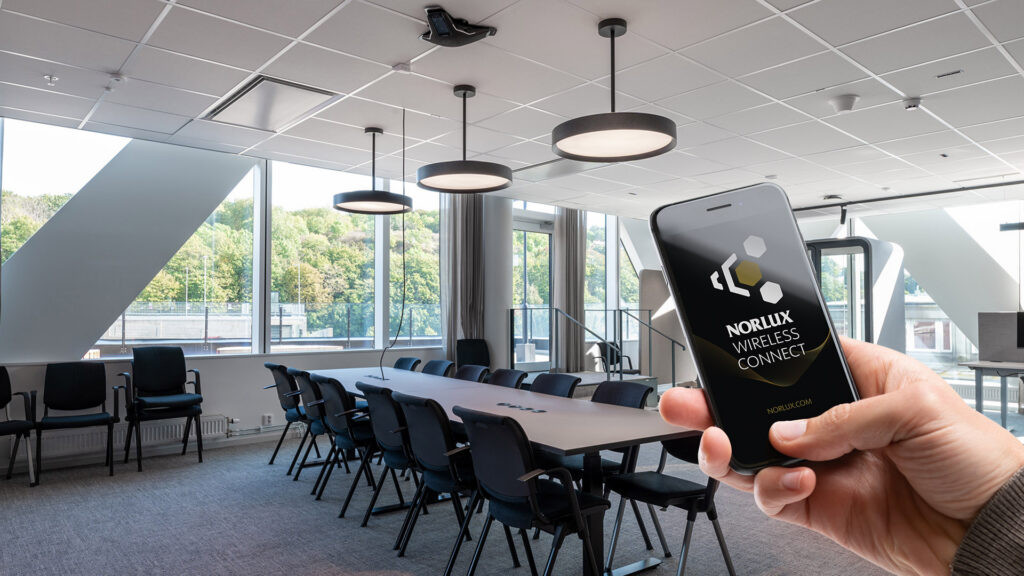
Norlux Wireless Connect is our wireless lighting control system that combines compatible LED -luminaires and control components including sensors, schedules and automatic regulation. The system allows for lighting tailored to needs and can be used in both new buildings and renovations.
With the right solution, the lighting can be adapted to the building's actual needs, while the system becomes easier to control and monitor.
Read about Norlux Wireless Connect
Explore Norlux Light Management Systems
Frequently asked questions about lighting control
Are you planning a lighting project?
Norlux helps you find lighting solutions tailored to your project's needs – from lighting design and product selection to control and documentation.