

RoHS and the phasing out of fluorescent tubes – what does it mean for existing lighting systems?
In 2023, manufacturers and importers were banned from bringing new mercury-containing T5 and T8 fluorescent lamps to the EU/EEA market. For owners and operators of commercial and public buildings, this raises several questions: Can existing fluorescent lamps still be used? Does the entire fixture have to be replaced? And when is it worth upgrading to LED ?
In short
The ban from 2023 applies to new fluorescent tubes being introduced to the market – not the use of fluorescent tubes that are already installed. Retailers can still sell off older, legally traded stock, but the supply of traditional fluorescent tubes will gradually be reduced. When upgrading, both LED -fluorescent tubes and new LED -luminaires are relevant alternatives. A replacement also provides the opportunity to improve lighting conditions, reduce energy consumption and adapt the lighting to the building's needs.
What is the RoHS Directive?
RoHS stands for Restriction of Hazardous Substances and is an EU directive that restricts the use of certain substances harmful to health and the environment in electrical and electronic products.
The directive covers, among other things, lead, cadmium, mercury and several other regulated substances. The purpose is to reduce the risk that these substances harm people or the environment during production, use and waste management.
Traditional fluorescent tubes work using an electrical discharge that involves mercury. The substance is necessary for the tubes to produce light, but mercury is also an environmental toxin that can cause significant damage if released into the environment.
The RoHS regulation has previously granted time-limited exemptions for the use of mercury in various light sources. For the most common fluorescent tubes for general lighting, these exemptions expired in 2023.
It is important to distinguish between a ban on placing new fluorescent tubes on the market and a ban on using existing fluorescent tubes. The RoHS phase-out does not mean that functioning fluorescent tubes must be removed from buildings.
Which fluorescent lamps are being phased out?
The phase-out includes several types of mercury-containing fluorescent lamps for general lighting.
| Type of fluorescent lamp | RoHS Exemption Expiration Date |
|---|---|
| T2 fluorescent tube – triphosphor tube with normal lifespan | February 24, 2023 |
| T12 fluorescent tube – triphosphor tube with normal lifespan | February 24, 2023 |
| Compact fluorescent lamps for general lighting – exemptions 1(a)–1(e) | February 24, 2023 |
| Straight triphosphor fluorescent lamps with a long life of at least 25,000 hours – exception 2(a)(5) | August 24, 2023 |
| T5 fluorescent tubes – triphosphor tubes with normal lifespan | August 24, 2023 |
| T8 fluorescent tube – triphosphor tube with normal lifespan | August 24, 2023 |
| Compact fluorescent lamps under 30 W with a lifetime of at least 20,000 hours – exception 1(g) | August 24, 2023 |
The dates refer to the expiry of the specified RoHS exemptions. Some specialist light sources may be subject to other provisions and exemptions. The phase-out does not mean that functioning fluorescent lamps that are already installed must be removed.
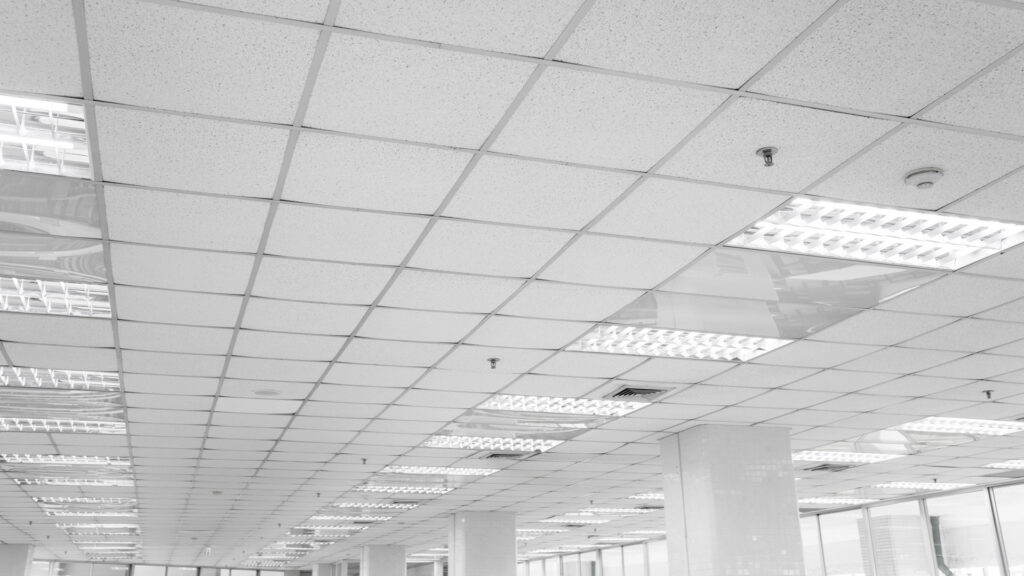
T5 and T8 fluorescent tubes have been widely used in office buildings, schools, shops, warehouses, industrial premises and other work environments. Many of these installations are still in operation.
The dates refer to the expiry of the current exemptions for mercury in general lighting lamps. Certain specialist lamps are covered by other provisions and exemptions.
Can existing fluorescent tubes still be used?
Yes. Fluorescent tubes that are already installed can still be used as long as they are working and in good condition.
The RoHS regulations do not require building owners to remove functioning fluorescent tubes as a result of the phase-out.
This means that a business with an existing fluorescent lighting system does not necessarily need to replace the lighting immediately.
However, there may be good reasons to plan for replacement. As fluorescent tubes cease to function, the availability of suitable replacement products will become more limited. Older fixtures and electrical components may also have increasing maintenance needs.
For buildings with many fluorescent tubes, it therefore makes sense to survey the system before a lack of spare parts or increasing maintenance costs create operational problems.
Can you still buy old fluorescent tubes?
The phase-out means that new mercury-containing fluorescent lamps covered by the ban can no longer be placed on the market in the EU/EEA.
Products that were already legally placed on the market before the relevant deadlines can generally still be sold from existing stocks. It is therefore possible that some fluorescent tubes may still be available from retailers.
However, there is a difference between goods that were already legally traded before the deadline, and goods that are only to be imported or placed on the market now.
Access to older inventory is not a long-term solution for buildings that rely on regular replacement of fluorescent tubes.
RoHS regulations are still evolving
Although the most common fluorescent tubes were phased out in 2023, the development of the RoHS regulations has not been completed.
The EU regularly reviews and updates exemptions for the use of hazardous substances in electrical and electronic products. In June 2026, the Norwegian Environment Agency informed about new applications for extension of exemptions for mercury, including for certain specialized light sources for UV lighting and emergency lighting.
This does not mean that the phasing out of common T5 and T8 fluorescent tubes for general lighting has been reversed. However, it shows that the regulations must be adapted to technological developments and the possibilities for replacing hazardous substances in various applications.
In an article published in Byggfakta Nyheter in October 2026, Lyskultur emphasizes that building owners and property managers should use the phase-out as a starting point for long-term planning of their lighting systems.
For businesses with large building masses, it is therefore sensible to follow developments in the regulations and at the same time assess the consequences it will have for future investments, product choices and maintenance.
Does the entire fixture need to be replaced?
Not necessarily. There are several ways to upgrade an existing lighting system.
In some cases, traditional fluorescent tubes can be replaced by LED -fluorescent tubes in the existing fixture. Other times it may be appropriate to rebuild the fixture or replace it with a new one LED -lamp.
Which solution is best depends on the age of the luminaire, its technical condition, compatibility and lighting requirements, among other things.
Option 1: Replace the fluorescent tubes with LED -fluorescent lamp
LED -fluorescent tubes have been developed to replace traditional fluorescent tubes in some existing fixtures.
This can be a cost-effective solution if the luminaire is in good condition and still provides satisfactory lighting.
However, it is not the case that all LED -Fluorescent tubes fit in all existing fixtures.
Compatibility depends, among other things, on which ballast the luminaire uses, and whether LED -The fluorescent tube is designed for exactly this solution.
Some LED -fluorescent tubes are designed for direct replacement without any changes to the fixture. Others require rewiring or modification.
According to the Directorate for Civil Protection and Emergency Preparedness (DSB), a CE marked LED -fluorescent tubes intended for direct replacement are installed without modification when compatible with the luminaire. If the luminaire needs to be rewired or modified, the work must be carried out by a registered electrical contractor or the manufacturer.
When rebuilding, responsibility for safety, necessary documentation and marking must also be taken into account.
Option 2: Switch to new ones LED -lamps
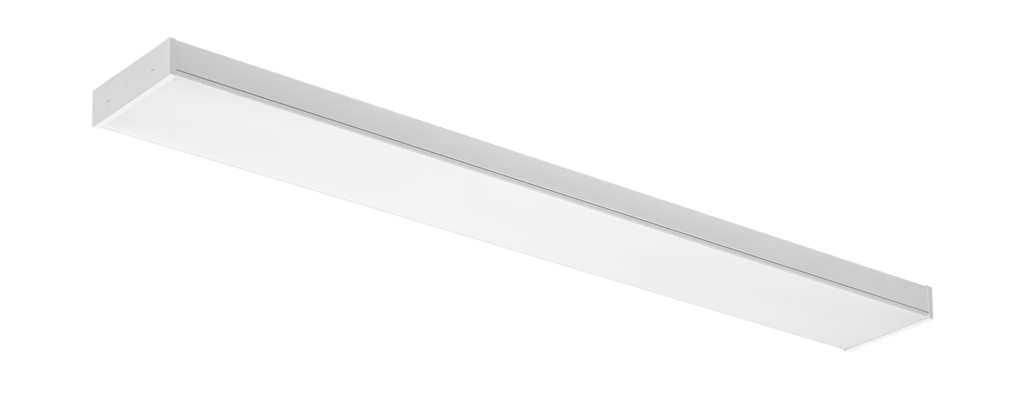
If the existing luminaires are old, have high energy consumption or do not provide satisfactory lighting conditions, it may be more appropriate to replace the entire luminaire.
Modern LED -luminaires are developed with optics, electronics and light distribution adapted to LED technology.
This provides greater opportunity to plan the lighting according to the room's function and the users' needs, rather than continuing the limitations of the original installation.
A luminaire replacement can also make it easier to introduce modern lighting control and reduce the need for future maintenance.
LED -fluorescent or new LED -faucet – what should you choose?
Both options can be good solutions. The most important thing is to consider the entire system and not just the cost of the light source itself.
| Rating | LED -fluorescent tubes in existing fixtures | New LED -lamp |
|---|---|---|
| Investment | Often lower initial cost | Normally higher initial cost |
| Reuse | Preserves existing fixture | Requires replacement of fixture |
| Light quality | Depends on existing fixture and LED -fluorescent lamp | Greater opportunity for customized optics and light distribution |
| Energy efficiency | Can reduce energy consumption | Can be optimized for desired lighting |
| Lighting control | Depends on compatibility and existing facilities | Greater opportunity for integrated management |
| Maintenance | Older components may still require maintenance | Possibility of a new facility with a documented lifespan and maintenance needs |
A luminaire that is still technically sound may have a significant remaining lifespan. Reuse can therefore be a sensible choice both financially and in terms of resource use.
At the same time, it is important to take into account that an older luminaire does not necessarily provide optimal light distribution with a new one. LED -light source. Such a replacement should therefore be considered against the lighting requirements in the room.
It is also not a given that replacing the entire fixture is always the best environmental choice. An overall assessment should take into account material use, energy consumption, expected lifespan, repairability and future maintenance.
How to prioritize upgrading existing lighting?
For property managers, it can be difficult to decide which lighting systems should be upgraded first. An old system may not necessarily be bad, while a newer system may have high energy consumption or unsatisfactory lighting conditions.
A systematic assessment should therefore look at both the technical condition and how the lighting works in practice. Premises with long operating times, high energy consumption or high maintenance requirements may be natural places to start.
In other areas, poor light distribution, glare or changed use of the premises may be more important reasons for upgrading.
By combining mapping of existing installations with lighting calculations and assessment of energy use, it becomes easier to prioritize measures. The result can be a gradual upgrade where investments are made when the need and benefit are greatest.
Phasing out fluorescent tubes is an opportunity to improve the lighting system
When an older lighting system is to be upgraded, it is natural to ask whether the original solution still meets the building's needs.
An office landscape may have a different layout. A warehouse building may have changed the shelving arrangement or work tasks. In a school, the rooms can be used more flexibly than before.
Lighting should be adapted to current activities, not just the original installation.
Correct light level and better visual comfort
A successful upgrade is not necessarily about getting more light, but about getting the right light.
Light level, uniformity, color rendering, light distribution and glare are factors that affect how we experience a room and how well we can perform various work tasks.
For indoor workplaces, NS-EN 12464-1 is a key standard for planning lighting.
The standard includes, among other things, maintained illuminance, glare, color rendering and illumination of various surfaces in the room.
UGR (Unified Glare Rating) is used, for example, as a measure of discomfort glare from luminaires. When replacing lighting in offices and other work environments, glare should be considered together with light level and luminaire placement.
A lighting calculation can help document that the planned solution provides the correct lighting conditions for the activity that will take place in the room.
Lower energy consumption with proper lighting control
Transition from traditional fluorescent lamps to LED can significantly reduce energy consumption, but the actual savings depend on several factors.
Among other things, one must look at the existing installed power, which new solution is chosen, operating time and how the lighting is controlled.
In many existing buildings, the lights are on longer than necessary, or all fixtures are turned on even if only parts of the room are in use.
Lighting control can help reduce unnecessary energy use through, among other things:
- Presence control: The light is adjusted when rooms or areas are in use.
- Daylight control: The electric lighting is regulated according to the availability of natural daylight.
- Time control and dimming: The lighting is adapted to operating hours, activities and the need for different light levels.
In rehabilitation projects, wireless control systems may also be relevant because they can reduce the need for new control cables.
Norlux Wireless Connect – wireless lighting control during rehabilitation
When replacing older fixtures, it may be appropriate to choose new ones. LED luminaires with Norlux Wireless Connect integrated.
The system uses wireless Bluetooth Mesh communication, allowing luminaires to be controlled individually or in groups without the need for additional control wiring. Existing power wiring can in many cases be retained, provided the installation is suitable.
This is what Norlux does Wireless Connect particularly interesting when renovating older lighting systems, where establishing a new wired control system could otherwise entail extensive installation work.
Depending on which luminaires and components are selected, the system offers options for, among other things, dimming, sensor control, zone division and time control. The lighting is configured and managed through Norlux Wireless Connect app.
By combining energy-efficient LED -luminaires with lighting control tailored to your needs can reduce unnecessary energy use and at the same time provide a more flexible lighting solution.
Look at the costs throughout the entire life cycle
The cheapest solution at installation is not necessarily the most economical over time.
For buildings with many luminaires and long operating times, energy use and maintenance can constitute a significant part of the overall cost.
By comparing investment cost, expected energy use, lifespan and maintenance needs, the building owner gets a better basis for decision-making.
Such an assessment can also highlight whether it is most appropriate to carry out an overall upgrade or replace the lighting in stages.
How should old fluorescent tubes be handled?
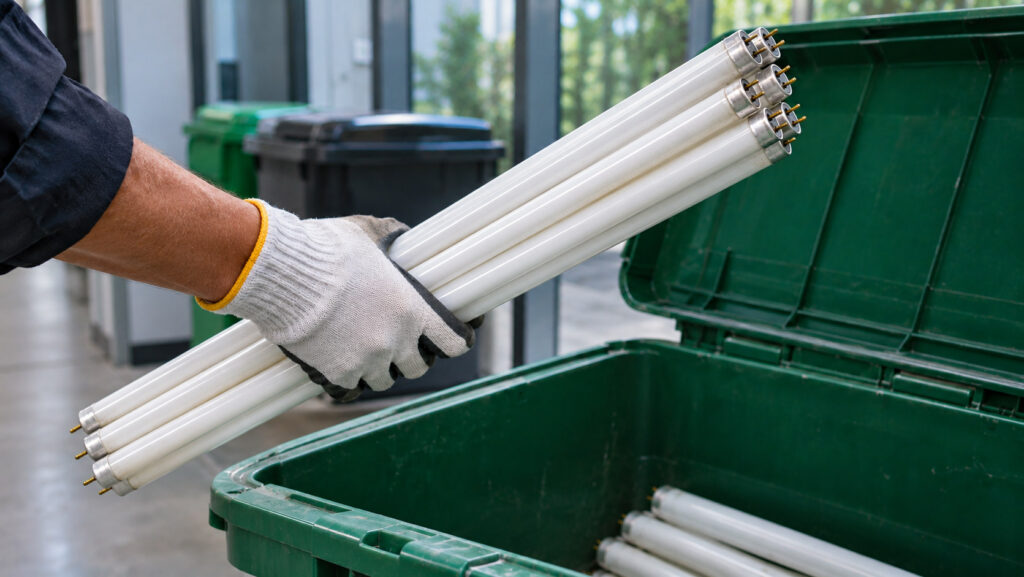
Traditional fluorescent tubes contain mercury and must be treated as hazardous waste when discarded.
They should not be thrown away in the residual waste or mixed with ordinary construction waste.
The fluorescent tubes should be stored and transported so that they do not break, and delivered to an approved collection point or a relevant return scheme for WEEE.
For larger rehabilitation projects, proper dismantling, collection, sorting and waste management should be included in the planning.
This ensures that mercury and other materials are handled in a controlled manner.
How can Norlux help with replacing fluorescent tubes?
Norlux helps building owners, property managers, consultants and installers find solutions for upgrading existing lighting systems.
The starting point is to map the current installation and assess how a new solution can be adapted to the building's functions, users and financial framework.
Depending on the project's needs, Norlux can contribute with needs analysis, lighting design, lighting calculations, selection of luminaires, lighting control and technical documentation.
For larger facilities, the assessment can also form the basis for prioritizing measures and planning a phased upgrade.
The goal is not just to replace old light sources, but to find a solution that provides good lighting conditions, appropriate energy use and predictable operating costs over time.
Frequently asked questions about phasing out fluorescent tubes
Are you planning a lighting project?
Norlux helps you find lighting solutions tailored to your project's needs – from lighting design and product selection to control and documentation.