

BREEAM-NOR and lighting – what must a project take into account?
BREEAM-NOR and lighting are closely linked in construction projects with requirements for sustainability and documentation. It is not enough to choose energy-efficient luminaires. The lighting must also take into account visual comfort, control and environmental considerations. Here you will get an overview of what the project should take into account, and which conditions should be clarified before the solutions are determined.
In short
BREEAM-NOR assesses the overall sustainability performance of the building, not individual products. For lighting, light level, glare, flicker, energy use, lighting control, light pollution and product documentation may be relevant. Which criteria a project must meet depends on the certification scheme, manual version, building type and the project's chosen BREEAM strategy.
What does BREEAM-NOR mean for the lighting project?
BREEAM-NOR is a certification scheme used to assess the sustainability performance of buildings. The scheme looks at several aspects of a construction project, including energy, health and indoor environment, materials, pollution and project implementation.
Lighting affects several of these areas. A lighting solution should provide good conditions for the people using the building, while limiting unnecessary energy use and environmental impact. For a project to be BREEAM-NOR certified, relevant properties must also be documented.
It is important to distinguish between BREEAM-NOR certification of the building and the documentation that accompanies a luminaire. A luminaire is not “BREEAM approved”. However, the product’s properties and documentation can be used as a basis when the project is to demonstrate that certain criteria have been met.
BREEAM-NOR and lighting: which requirements are relevant?
The following topics are particularly relevant in BREEAM-NOR for new buildings v6.1.1 . The overview is not a complete list of requirements. It shows where the lighting discipline typically comes into play in the project work.
| Topic | What could be relevant to the lighting? |
|---|---|
| Hea 01 – Visual comfort | Light level, glare, flicker, daylight, zoning and the ability for users to regulate the light. |
| Ene 02 – Energy measurement | How energy use for lighting can be included in the building's measurement and monitoring system. |
| Ene 03 – Outdoor lighting | Energy-efficient outdoor lighting and automatic control to avoid unnecessary operation. |
| Pol 04 – Reduction of light pollution | Control of stray light, light direction, shielding and operating times outdoors. |
| Food 02 – Sustainable material choices – product requirements | Environmental product declarations (EPD), product overview and relevant substance and material documentation. |
| Mon 04 / Mon 05 – Commissioning, handover and follow-up | Functional testing, user and operational guidance, documentation and any follow-up after takeover. |
Visual comfort: more than the right amount of lux
A good lighting environment is not just about how much light hits a work surface. It's also about how the light is distributed in the room, whether the fixtures are dazzling, and whether the lighting is suitable for the activities that will take place there.
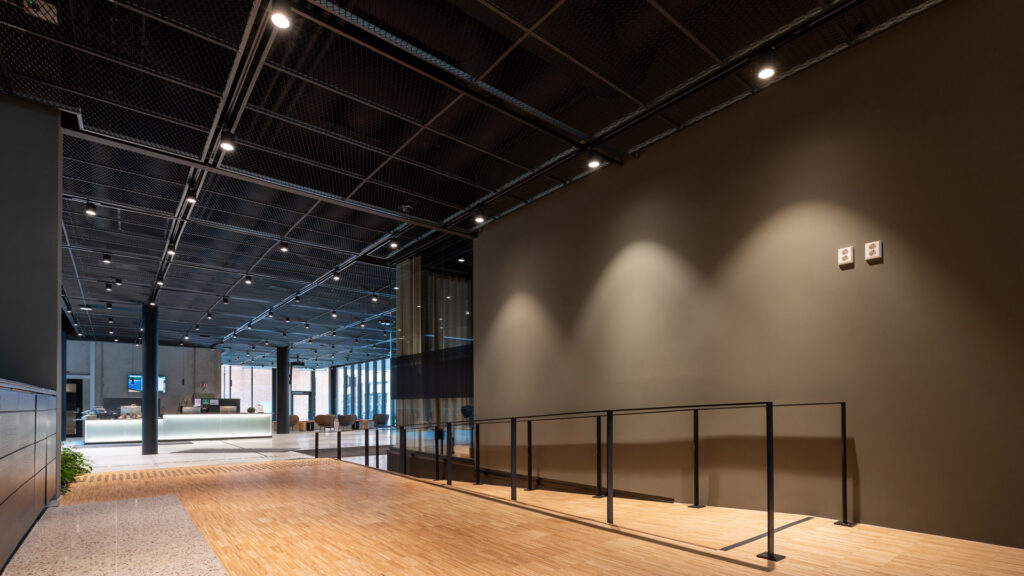
In BREEAM-NOR it may be relevant to document light levels, uniformity and glare through lighting calculations. Flicker and stroboscopic effects from LED -lighting and drivere must also be considered. In addition, zoning and separate user control may be relevant, so that different rooms and work areas receive lighting that is adapted to their needs.
Daylighting, solar shading and electrical lighting should be planned together. This often requires collaboration between the architect, consulting engineer, lighting designer and lighting control supplier.
Energy and lighting management: the right light at the right time
Energy efficient LED -luminaires are a good starting point, but the actual energy use also depends on installed power, operating time and how the system is controlled.
Presence control, daylight control and adapted light levels can help to ensure that the light is not on at full strength when it is not needed. In projects where energy measurement is part of the BREEAM strategy, it must also be clarified how the lighting is included in the building's system for measurement and follow-up. Read more about how lighting control can reduce energy consumption .
For outdoor lighting, requirements for energy efficiency and automatic control may be particularly relevant. It is not necessarily sufficient to refer to the light output of a single luminaire: In relevant assessments, it is the overall installation and control functions that must be documented.
Light pollution: illuminate only what needs light
Outdoor lighting can create safety and make areas easier to use after dark. At the same time, incorrect lighting direction, too high levels or unnecessarily long operating times can create annoying stray light and affect the surroundings.
BREEAM-NOR has a separate topic for reducing light pollution. When planning outdoor areas, one should consider, among other things, the light distribution and mounting angle of the luminaires, any shielding, the impact on neighbours and the times the lighting should be in operation. Necessary safety and security lighting must be considered separately.
Product documentation: EPD is useful, but not the whole answer
An EPD ( Environmental Product Declaration ) is a third-party verified environmental declaration that provides standardized information about a product's environmental impact throughout defined parts of its life cycle.
In BREEAM-NOR, EPDs can be relevant documentation in the work with material and product requirements. However, the project must check that the declaration applies to the correct product or product variant, meets the requirements of the relevant manual and is valid at the relevant time.
An EPD does not in itself document that a product meets all the environmental requirements of the project, nor does it state whether the designed lighting provides good visual comfort or low energy consumption. This must be assessed and documented separately.
Commissioning and handover: the solution must work in practice
A good lighting solution is not complete when the luminaires are installed. Sensors, control zones, dimming levels and time functions must be programmed and tested in accordance with the project's functional description.
Operational personnel need documentation to operate and maintain the system, while users need an understandable explanation of how the lighting works. In projects with trial operation, it may also be relevant to adjust the control after the building has been put into use.
What documentation should a project request?
In a BREEAM-NOR project, it is useful to distinguish between three types of substrates:
- Product documentation: Datasheet, information about the luminaire and driver , flicker data, EPD and other relevant environmental documentation.
- Documentation of the designed solution: Lighting calculations, luminaire placement, installed power, zoning, control strategy and assumptions for the calculations.
- Documentation of delivered and commissioned systems: Updated fixture and component lists, function tests, programming documentation, FDV and any control measurements.
These levels complement each other. A data sheet shows the properties of a product, but not necessarily how it will function in a particular room. A lighting calculation documents a designed solution, but must be updated if significant assumptions or products change before completion.
Five clarifications that should be made early
Many challenges can be avoided by clarifying requirements and responsibilities before selecting fixtures and control systems.
- Which BREEAM-NOR scheme and manual version applies? The requirements are version-dependent, and the assessment must be based on the project's registered basis.
- What topics and points are included in the project's strategy? Not all possible BREEAM topics are necessarily targets for the individual project.
- What functions and lighting requirements apply to the rooms and outdoor areas? Room use, work situations, daylight access and need for control affect the solution.
- Who is responsible for calculations, product data, programming and documentation? This must be divided between the client, designer, contractor, system supplier and other parties involved.
- How are changes and product replacements handled? The documentation delivered at completion must match what is actually installed.
The project's BREEAM-NOR AP and auditor are central to clarifying criteria and documentation requirements. A lighting supplier can contribute relevant documentation, but does not automatically assume responsibility for the project's certification.
How can Norlux contribute to a BREEAM-NOR project?
Norlux can help with the planning and development of lighting solutions that take into account both function, energy efficiency and documentation needs. Depending on the project and agreed delivery, this can include lighting design, lighting calculations, luminaire selection, lighting control, product data, environmental documentation and technical support for the project.
By clarifying the requirements early on, it becomes easier to choose solutions that work in the building – and to collect the right documentation along the way. The final assessment of whether the BREEAM-NOR criteria are met is made through the project's own certification process.
Frequently asked questions about BREEAM-NOR
Artikkelen beskriver prinsipielle forhold og bruker BREEAM-NOR for nybygg v6.1.1 som eksempel. For konkrete prosjekter gjelder den registrerte manualversjonen, relevante tekniske avklaringer og prosjektets kravgrunnlag.
Are you planning a lighting project?
Norlux helps you find lighting solutions tailored to your project's needs – from lighting design and product selection to control and documentation.